UM-Flint exhibition examines the university's role in Flint's urban renewal era
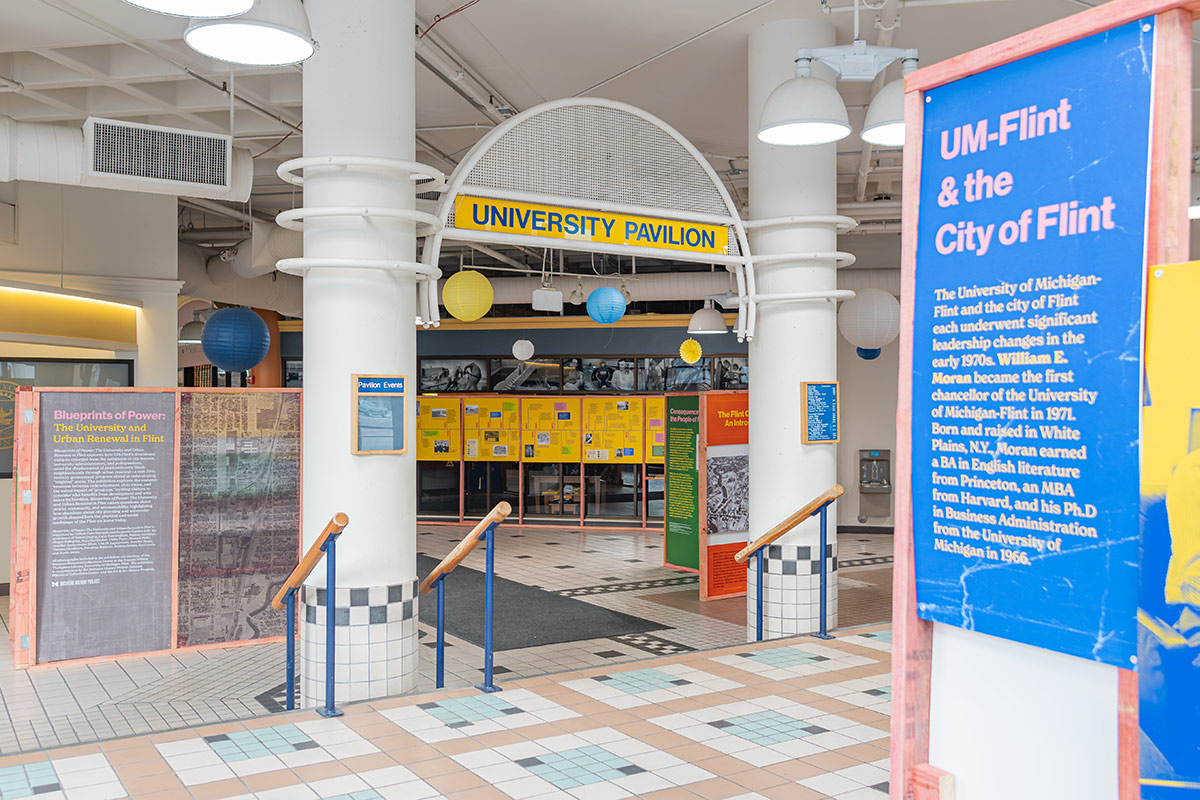
The University of Michigan-Flint has spent recent years working to deepen its roots in the city it calls home — offering free tuition to Flint-area students through the Go Blue Guarantee, establishing and hosting annual community traditions such as Inclusive Halloween, and launching research initiatives that allow professors to work alongside residents as partners. A new exhibition in the university's campus pavilion asks visitors to hold that present-day commitment alongside a more complicated chapter of the institution's past, while also showing the impact that confronting that history had on the students who built it.
"Blueprints of Power: The University and Urban Renewal in Flint," on display through the end of July, was developed as part of UM-Flint's Inclusive History Project.
The Inclusive History Project spans the University of Michigan's Ann Arbor, Dearborn, and Flint campuses. Described as a "journey of institutional self-discovery," it is designed to move beyond the origin stories universities typically tell about themselves, examining the full arc of an institution's history — including its histories of exclusion. In March, UM-Flint hosted the annual IHP Summit, bringing together university community members, alumni, and Flint residents for research presentations and roundtable discussions, including one focused specifically on urban renewal and its legacy.
The exhibit itself deals with mid-20th-century urban renewal and federal freeway expansion programs developed around the U.S., and how predominantly lower-income, Black and Brown neighborhoods often paid the price. In Flint, one of those neighborhoods was St. John's Street, which was razed to make way for I-475. This exhibition examines the long-term impact and explores how the university's own expansion into downtown Flint intersected with those decisions and their consequences.
The exhibition was co-led by Benjamin Gaydos, a professor of art and design and director of UM-Flint's Community Design Studio, and Callum Carr-Marquis, associate archivist and head of archives at the Frances Willson Thompson Library. Carr-Marquis developed the exhibition's historical narrative, drawing on primary-source documents from the Genesee Historical Collections Center to piece together the story, before handing it off to students for design and fabrication.
Before beginning work on this project, Carr-Marquis felt that the university's records from that era hadn't been thoroughly examined through a contemporary lens. Their research revealed how intertwined the institution and the city of Flint were. "There is such a wealth of information in our earliest records as a university," they said. "I found the correspondence in the Chancellor Collection to be especially incredible. The back-and-forth between various groups, stakeholders, politicians, and Chancellor (William) Moran provided a fascinating window into Flint's powerbrokers during the 1970s."
But the exhibition's real engine was the classroom. Gaydos' Community Design Studio course spent more than two years building toward the final installation, growing out of his long-standing relationship with the St. John Street Historical Committee, with whom he has collaborated to develop a memorial park commemorating the neighborhood. Gaydos built the project around giving students hands-on ownership of every stage — research, design, and fabrication alike.
"You can't teach care," Gaydos said. "But you can show it. I think giving students the opportunity to learn outside of the classroom is paramount to them learning how to be good citizens, good people."
For the students who stayed with the project after their coursework ended, that opportunity reshaped their sense of direction entirely. Megan Pellegrini, a 2025 graphic design graduate, designed every panel in the final exhibition after being drawn into the project through an earlier studio course focused on St. John Street signage and park planning. The deeper she got into the material, the more it clarified what she wanted her design work to do.
"This exhibition was a way of exploring how this urban renewal happened within the Flint area and what people it displaced," Pellegrini said. "Using graphic design as a vehicle to help solve, or help further along, some of these projects that will, in the long run, help out communities has reframed my perspective on my work and my career."
Catie Cunningham, a 2026 fine arts graduate, joined the project through the same studio course and stayed on for fabrication and copyediting work after the semester ended. For her, the project didn't just inform her art — it pointed her toward an entirely new field.
"The project made me realize I have a real passion for urban planning," Cunningham said. "Once I realized that, it made so much sense with all of my interests, but it was never something I had connected before."
Both students said the research itself was eye-opening. Pellegrini, who had worked with the St. John Street group on earlier projects, said the exhibition broadened her understanding of urban renewal's reach. "It did kind of open my eyes to the broader effects of urban renewal and the effect the university had," she said.
That hands-on immersion extended well beyond research. When the studio's original cardboard exhibition design was scrapped due to fire-safety concerns just months before opening, students helped rebuild it from scratch using fire-resistant lumber — a process Gaydos said brought the whole team, including studio manager Tricia McDonald and facilities staff, into the campus wood shop to problem-solve. Cunningham took on much of the fabrication and materials work, building skills she's now applying directly to her own art practice, including building frames for an upcoming student show.
The work also left students with strong feelings about who should walk through the exhibition. Cunningham said she values that it lives on campus. "Having students learn the history of Flint, and learn what part they're playing, whether they know it or not, in the story of Flint, is really important."
Pellegrini agreed, but pushed the audience further — to Flint natives themselves, including people like her own mother, who grew up in the city. "I really encourage a lot of people to get more out there and see some of these exhibits," Pellegrini said. "I think we should all engage the community at regular events like the Flint Art Walk, that sort of thing."
For both students, the project didn't end when their coursework did. Pellegrini now works part-time with the Inclusive History Project on a related design initiative, work she said has pushed her to develop more accessible, community-minded design rather than what she calls "corporatized graphic design," which can leave viewers feeling shut out. Cunningham, meanwhile, said the exhibition's themes — how power and place shape the people who grow up within them — are now showing up directly in her personal art practice as she builds a portfolio for graduate school on her path to becoming a professor.
Carr-Marquis said the project shifted their own focus as an archivist, sharpening an instinct to document the present so future generations aren't left piecing together the past from scattered fragments. "I think of myself as an activist archivist," Carr-Marquis said, "somebody who collects as history is happening."
Gaydos hopes the exhibition reaches beyond the classroom to city officials, planners, and longtime Flint residents — and he's working to bring it to the St. John Street Historical Committee's annual reunion in August. "I hope this exhibition shows that we, as a university, are reckoning with our past actions," he said. "Because it's the only way we'll be trusted by the community to be part of creating a more inclusive and equitable future for Flint."
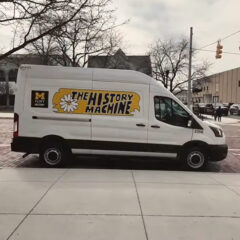
"Blueprints of Power: The University and Urban Renewal in Flint" is free and open to the public through the end of July in the UM-Flint Pavilion, 303 Saginaw St. The mobile exhibit will move to other locations throughout the area as part of UM-Flint community engagement initiatives.


- College of Arts, Sciences & Education
- Community
- History
- In the News
- University Events
- University News
- Visual Art

Kat Oak
Kat Oak is the communications specialist for the College of Arts, Sciences, and Education. She can be reached via email at katheroa@umich.edu.