For two weeks this spring, a group of University of Michigan-Flint students traded Flint’s familiar streets for the trains, temples, and tea ceremonies of Japan, immersing themselves in a study-abroad course centered on design thinking, a practice that can be applied broadly across disciplines.
Design thinking is the study of human-centered design that focuses on how people interact with tools, systems, and services to improve their usefulness. Since many of these practices can be culturally rooted, studying designers, artisans, and makers in another country can give students insight into innovative ways of working in their respective fields.
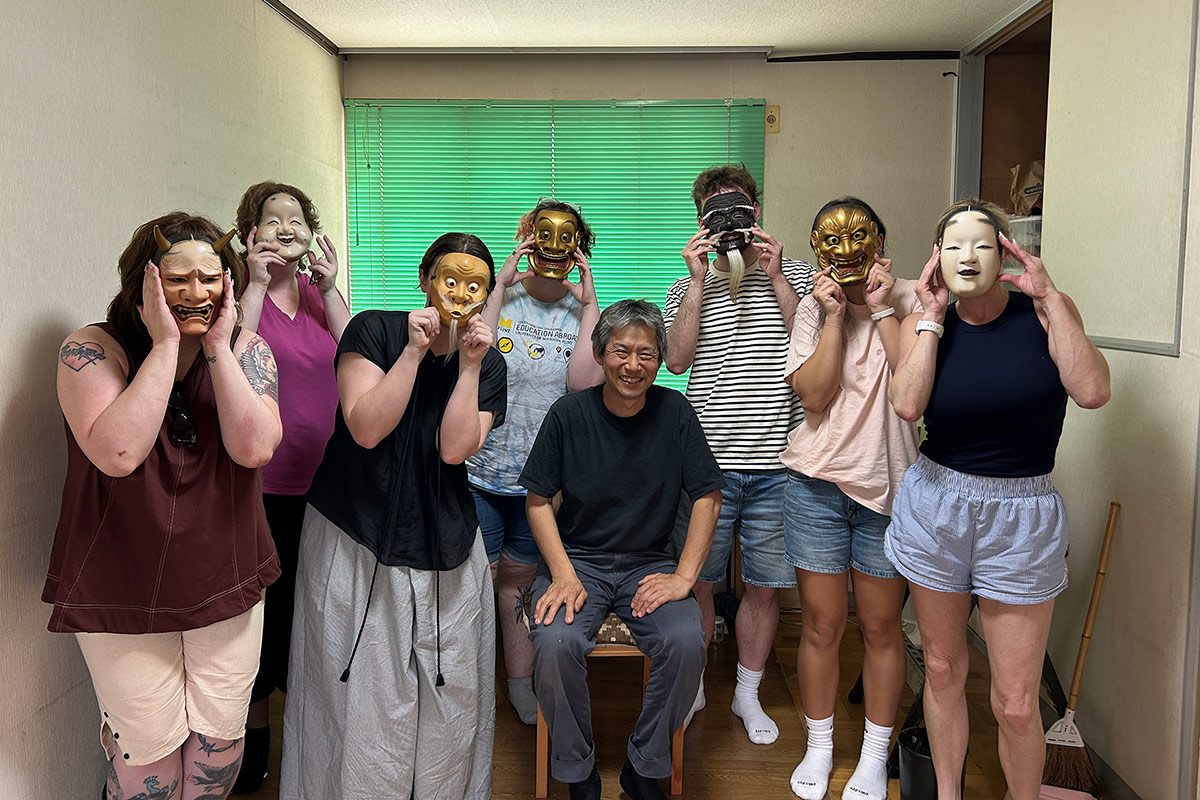
The itinerary ranged widely — from a homestay weekend and a Noh mask workshop to visits with master ceramicists in Bizen, a stationery company reimagining its workplace culture, and a sobering day at the Atomic Bomb Museum in Nagasaki. But for the students and faculty who made the trip, what stayed with them most wasn’t the locations; it was how the experience reshaped the way they see their own work, their own assumptions, and themselves.
For senior criminal justice and sociology major Jenna McIntire, this was her second time taking the course. The first trip, she said, had been overwhelming. “Last year, I was very intimidated by the idea of … traveling out of the country, and it was such a big change that culture shock definitely played a big role in my experience,” she said. “This time, I knew more of the rhythms of the program, what to expect culturally, and that freed me up to notice smaller, more fine-tuned details that I couldn’t have absorbed before.”
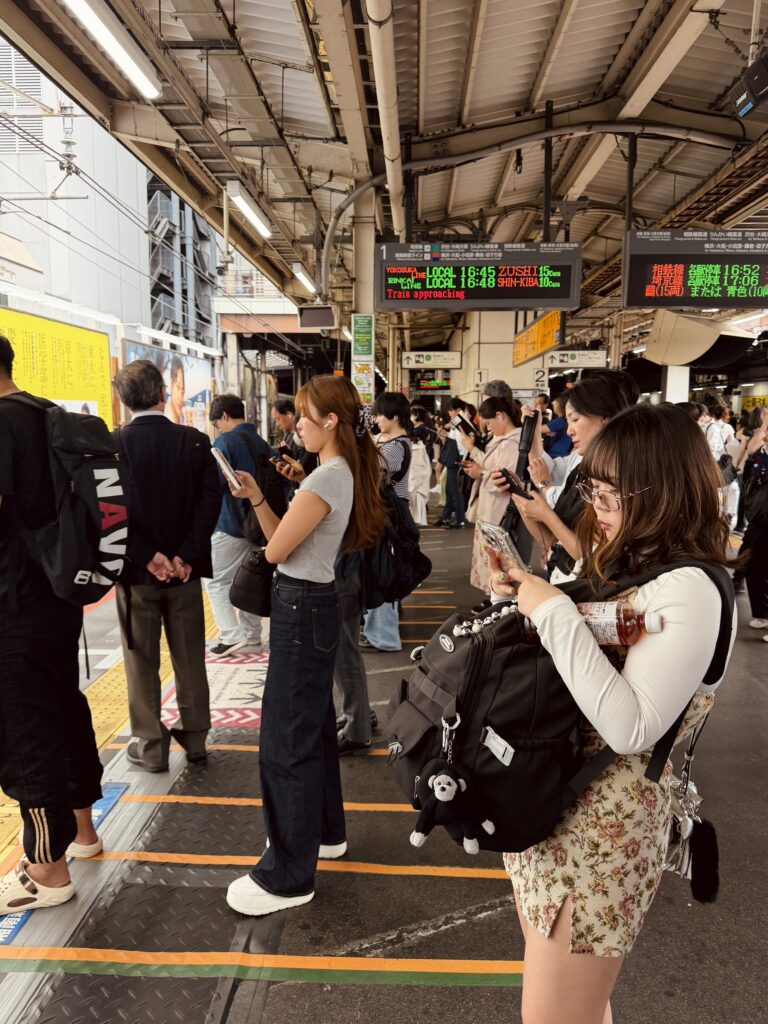
That shift showed up most clearly in how she navigated the country itself. Last year, she relied on the group dynamic and let others handle things like transit; this year, she spent a few extra days in the country after the course ended and found it more user-friendly than she had imagined. “I was surprised, and a bit shocked, by how easy it was to get around, how well designed everything was. I’m not used to riding buses and trains, but it was easy for me to navigate and get the hang of it — it was a completely different world doing it on my own, but it was incredible.”
McIntire’s favorite part of both trips was returning to the same homestay family, where she got to spend one-on-one time with her homestay mom. “We bonded over our shared love of stationery and journaling. As part of our course assignment, we had to create a journal about the experience, but it was very open-ended and allowed us to be creative,” she said. “It made it more meaningful to have this sort of artifact of the experience — a collage of the train tickets and museum passes alongside my written thoughts on the experiences.”
For Megan Kehoe, a BBA/MBA student working in service design at the consulting firm Cities Reimagined, the trip directly connected to her career. “The course description — combining design thinking, the arts, and infrastructure — made it a natural choice for me. It’s connected directly to my career but also my passion,” she said. Riding Japan’s public transit system left an impression she described through a cultural lens — efficient, quiet infrastructure that, she realized, reflects a collectivist culture rather than the individualist one she works within back home.
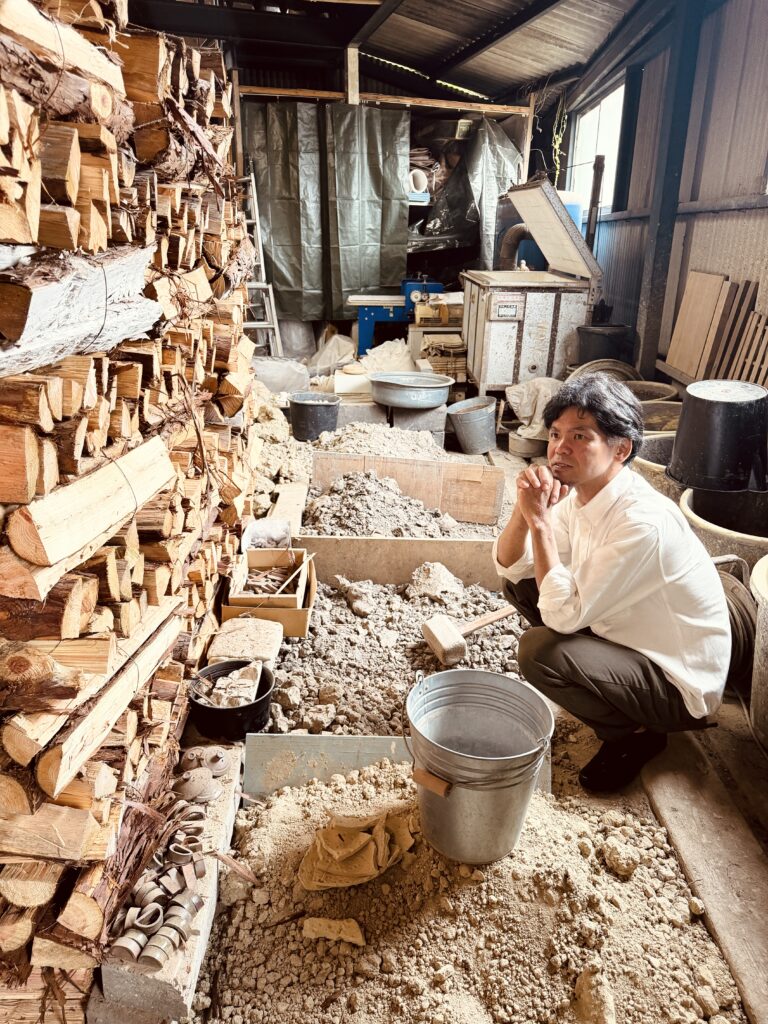
A visit to Kokuyo, a major Japanese stationery and office-design company, doubled as a hands-on design workshop, and Kehoe was struck by how differently problems are framed there. “We so often start with why things can’t happen,” she said of typical American business culture. “So it was really interesting and lovely to be a part of a design workshop that explored how things can happen. I felt very much in my element and excited.” A day in the ceramics village of Bizen left a similar mark, watching generations of the same families carry forward their craft. “I feel like we don’t really have that kind of familial artisan culture in America, so it was really special to experience,” she said.
The trip’s emotional center, for Kehoe, was Nagasaki, where the group met a survivor of the atomic bombing. “Hearing his tale, the recount of his life … that was just a once-in-a-lifetime experience,” she said. “I just felt very privileged to be able to be there.” For her journal project, she chose wabi-sabi, a Japanese aesthetic that encourages the acceptance of imperfection, as a lens for the whole trip. “I’m interested in the idea of what happens when inclusive design is a cultural value instead of just a department that’s neglected.”
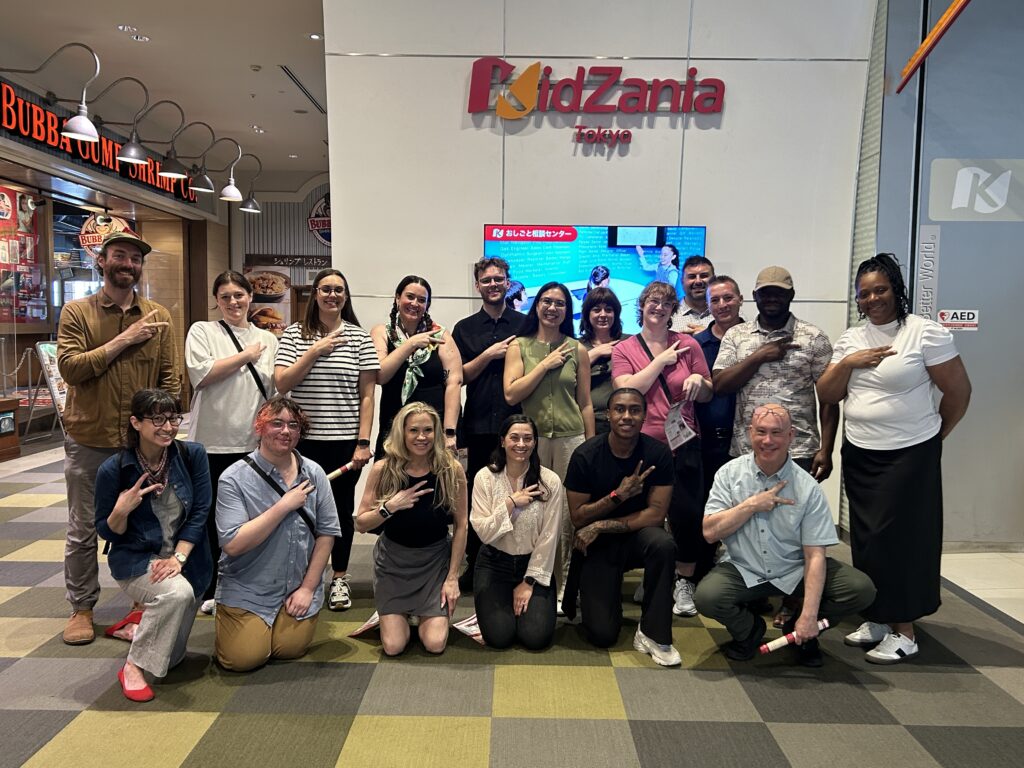
Among the sites that left an impression in both directions was KidZania Tokyo, where staff welcomed the group warmly into the children’s edutainment city. Satoshi Jorge Takahata, who works in international affairs at KidZania, captured the spirit of the exchange afterward. “Their interest, curiosity and thoughtful questions totally energized our team. It was seriously inspiring to watch them connect their classroom learning with real-world experiences right here at our facility,” he said. “We are incredibly grateful to be a part of their learning journey. We hope this visit sparked some fresh ideas, and we can’t wait to see these bright, passionate students grow and crush it in their future careers.”
Highly interdisciplinary in its design, the program was co-led by School of Management professor Greg Laurance and Fine & Performing Arts professors Shelby Newport and Benjamin Gaydos. Each brought a different type of expertise to the course’s dynamic.
Newport felt this year’s group of students stood out for how it gathered around food — from a bubbling tabletop stew and fried chicken in a Tokyo izakaya to a seafood dinner served on the floor in Nagasaki and a newfound enthusiasm for konbini runs. “They loved the convenience store runs! But food always brings people together and allows us to see other cultures in new ways,” she said. “It can be so powerful.”
Watching students engage with Kokuyo’s design workshop and the artisans of Bizen reinforced a question Newport now plans to bring back into her own teaching at UM-Flint. “I always learn so much about teaching design and production while in Japan that I bring to my teaching and creative activity throughout the year. This year, though, I think I will continue to use and emphasize the idea of ‘What is the real problem we are trying to solve?’” she said. “Getting to the heart of why something is designed the way it is, or what problem is the right one to be solving, can help us all. The students in this year’s course took to this investigative approach to human-centered design thinking.”
Laurence pointed to the program’s first extended stay in Nagasaki as a highlight — a mix of historical weight (the Atomic Bomb Museum, survivor lectures, an abandoned coal-mining island) and hands-on visits with artisans, including a kite maker and a blacksmith. “It was a successful and promising first visit, and I know that there is a lot more we can do there,” he said.
Beyond the itinerary itself, Laurence said he’s most interested in what students learn about themselves — including their harder moments on the trip. “I always hope that the experience gives students a lot to think about, not just in the immediate aftermath of the course but over time,” he said. “Beyond what they learned about Japan or about business and design, what did they learn about themselves? What do they look back on as not the most positive moments for themselves during the trip, and how did they react? What can they learn from those moments when they revisit them in 6 months or a year or two?”
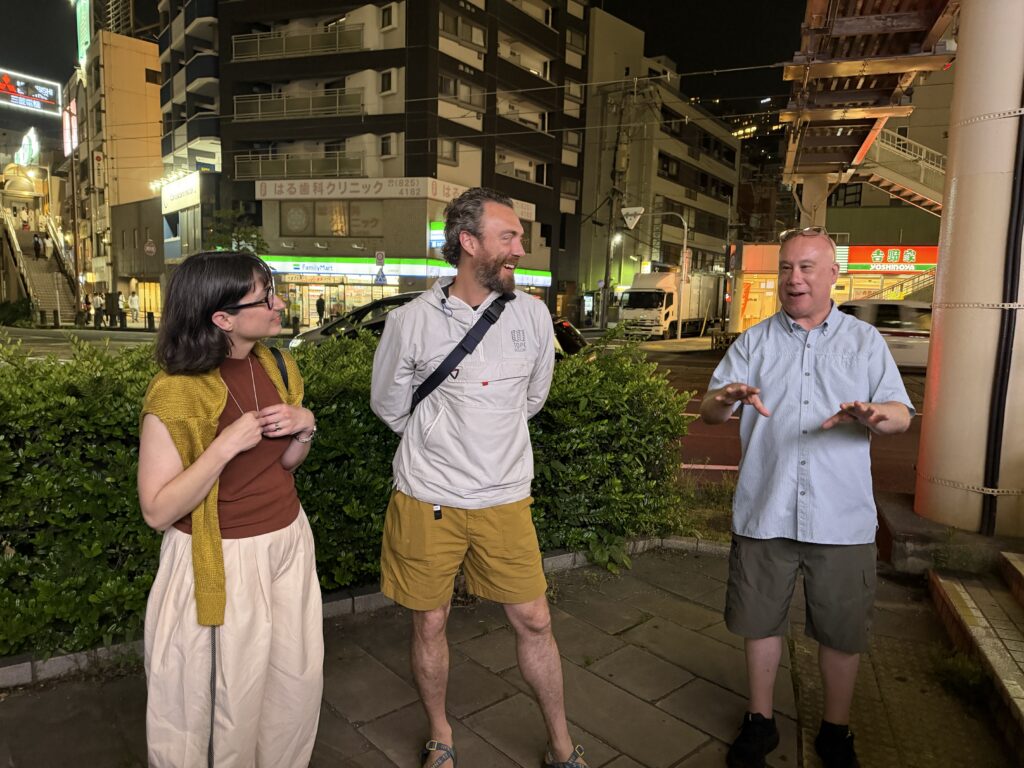
Gaydos watched the group’s confidence build day by day. “Some of the best learning happened between the planned activities — on trains, in convenience stores, during meals, while getting lost,” he said.
For him, the homestay weekend was the turning point; students returned with stories about making miso, picking vegetables, and family meals. “That experience shifted something for many of them,” he said. “I hope students leave with more confidence moving through uncertainty and a broader understanding of design — not only as objects or visuals, but as care, memory, hospitality, communication, and exchange. One message we received from Bizen described the students as curious, thoughtful, and open-minded, which felt like one of the best possible outcomes.”
As for the long-term impact this experience will have on Gaydos himself, it was the reflective process that stood out. “This trip reminded me how powerful structured reflection can be. The journal prompts helped students slow down, observe, and connect their experiences to broader ideas. I want to bring more of that intentional observation, reflection, and care into my teaching at UM-Flint.”
UM-Flint offers Design Thinking in Japan each spring. For more information about this program, contact Laurence at glaurenc@umich.edu.