UM-Flint course blends special education, math teaching methods
What if the future of teacher preparation isn't asking educators to specialize, but preparing them to do it all together?
Today's K-12 teachers are expected to deliver strong instruction while meeting the diverse needs of students with varying learning abilities. Yet teacher preparation has traditionally treated those responsibilities separately, with special education and content-area instruction taught in different classrooms, by different professors and through different coursework.
During the winter 2026 semester at the University of Michigan-Flint, assistant professors of education Sam Hilbert, a specialist in special education, and Jeramy Donovan, who focuses on mathematics education, set out to challenge that model. By co-teaching a mathematics methods course that intentionally integrated special education practices, they gave future educators the opportunity to experience the kind of collaborative, inclusive teaching increasingly expected in today's schools.
Donovan remained the instructor of record, but Hilbert sat in on every session, reviewing his lesson plans beforehand and weighing in live in front of students. "I never asked Jeramy to change any of his content," Hilbert said. "He would teach the math content, and then I would jump in with, 'Here's a way to think about this with a special education lens.' We did that with every single class."
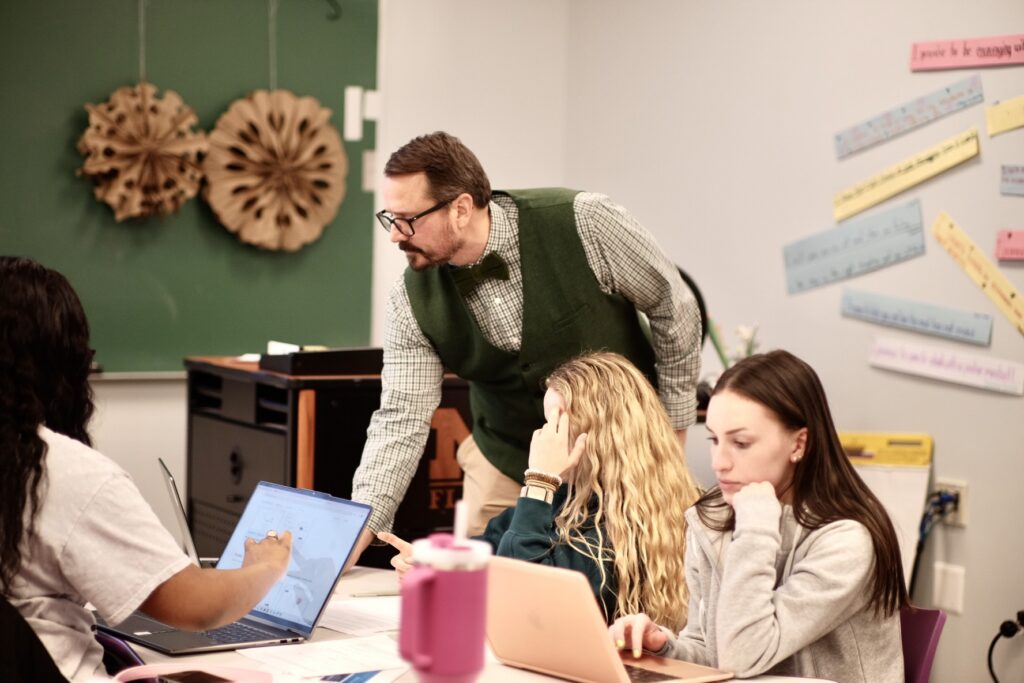
That back-and-forth showed up most clearly in a semester-long case study assignment. UM-Flint students tracked one struggling K-12 learner using OGAP—the Ongoing Assessment Project—a tool for pinpointing exactly which foundational math skill a student is missing. Hilbert layered special education practice on top of it, requiring these future teachers to review any Individualized Education Program or 504 plans—which outline the requirements and accommodations a student might need to ensure an equitable learning environment—and to treat them as required reading, not an afterthought.
"There was a sense of, 'It's not really my responsibility,' until they learned that it's just an inherent part of the class," Hilbert said. "These ideas are not separate. They are always together, and they are always embedded."
In the classroom, students began directing questions to whichever professor matched the subject—Hilbert for behavior and learning needs, Donovan for math content. "They knew, 'OK, Sam knows the special education side, so let me ask her these things, but don't ask her any of the math things,'" Hilbert said.
For the students, the shift was immediate. Jailyn Taylor, a senior elementary education major from Grand Blanc, set to student-teach second grade this fall, said the course felt unlike any other methods class she had taken. "It was more hands-on than any other classes that I've had, and actually applying teaching methods to actual student needs instead of learning things from a largely theoretical perspective," she said. "It was so engaging, and it was so helpful."
Taylor pointed to a one-on-one lesson with a kindergartner working through a "mystery shape" activity as a turning point. "That was a special moment to see what I'm teaching at their level, at their needs, was working, and it was impactful," she said. "They were having a blast, they were answering all my questions, so it was just so engaging and so memorable."
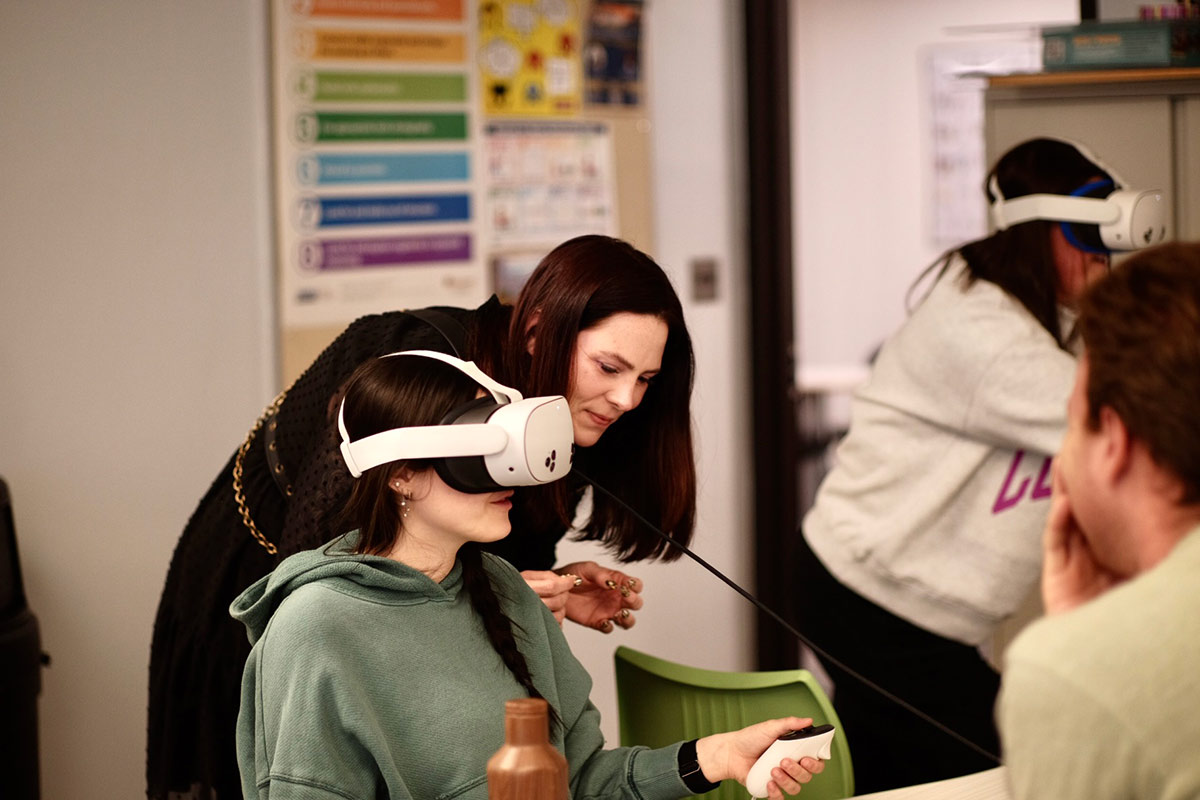
A technology day brought smartboards, the Bridges math curriculum and virtual reality headsets used for an addition game. "I've never done that before, so that was really engaging," Taylor said. Manipulatives—blocks, counters, even the Legos described in a classroom case study the students read — reinforced the same lesson: meet students where they are. "The use of manipulatives is a huge thing," Taylor said. "Making math hands-on totally changes the experience of learning it."
Meghan Nickerson, a senior elementary major from Flushing who spent three years as a special education paraprofessional before enrolling at UM-Flint, expected the course to focus mostly on general math, with occasional special education notes. Instead, she was happy to see that Hilbert was a full co-instructor. "It was a lot more special ed focused than just a regular math methods course than I was expecting," Nickerson said. "She was actually up teaching; she had prepared presentations—it was nice, I liked it a lot."
Nickerson pointed to an interactive day where Donovan set up various math stations around the room, and the students experienced the curriculum from the other side of the desk. "We became our future students, moving from station to station, playing different games or using different tools. It was really fun," she said.
Caleb Barter, a senior elementary education major from Davison, said the dual perspective will follow him into his own classroom this fall. "The course taught us how to create a learning environment that felt inclusive and welcoming for all students, as well as how to support students with differentiating needs," he said.
Students also pointed to the model itself—two professors staying in their own lanes while leaning on each other's expertise—as something they expect to carry forward. Taylor described pulling lessons from "Building Thinking Classrooms," a book assigned in the course, and realizing its ideas about safety, trust and embracing mistakes weren't math-specific at all. "This is really applicable to every subject and everything in life," she said. "You want your students to feel safe, comfortable, and to know that mistakes are okay. Mistakes are how we learn."
That, Hilbert said, is the point of doing the work inside a classroom built on collaboration before these student teachers ever lead a class of their own. "I want to create teachers who are successful at making their students successful."
Hilbert, Donovan, and their colleague Eric Common, also an assistant professor of education, have applied for grant funding to continue teaching this integrated course during the next five years, with the ultimate goal of establishing it as a regular part of UM-Flint's Education curriculum.
"Offering an innovative course like this requires several kinds of support — financially, we were funded by a Research and Creative Activity grant from UM-Flint, but professionally, we were supported by our department's chair and other Education faculty who are really interested in this approach," said Hilbert. "And, of course, the students—if they had said they didn't want to do it, then it wouldn't have been successful. But they were incredible; they took everything we offered them and just rolled with it. They made this experience phenomenal."
Kat Oak
Kat Oak is the communications specialist for the College of Arts, Sciences, and Education. She can be reached via email at katheroa@umich.edu.