This award-winning UM-Flint microbiology student is heading to Cornell
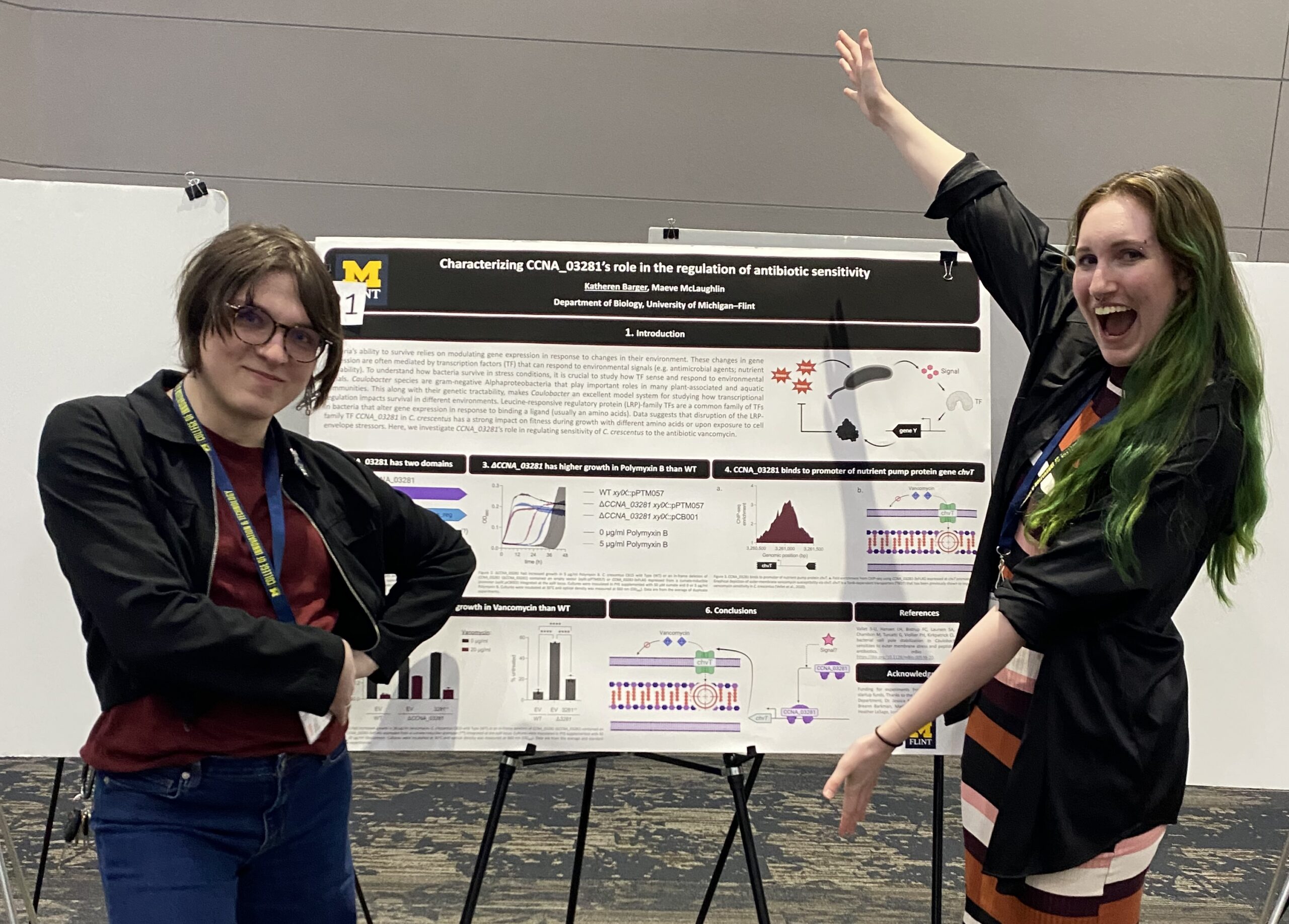
Katheren Barger had presented at research conferences before. They knew how to read an audience and translate complex science into something a layperson could grasp. But when they stepped in front of the poster to present at this year's conference of the Michigan Branch of the American Society for Microbiology, something felt different.
Barger, a senior at the University of Michigan-Flint's College of Innovation & Technology, won the undergraduate poster award at the statewide gathering of microbiologists — recognition that capped an undergraduate experience that also included co-authoring the first scientific publication out of their faculty mentor's lab. This fall, the Clio native heads to Cornell University to pursue a Ph.D. in microbiology.
Barger's research, conducted in the lab of Maeve McLaughlin, assistant professor of biology, focuses on transcription in bacteria — the molecular process by which bacteria read and respond to environmental stress signals. Specifically, Barger and McLaughlin have been studying the alphaproteobacterium known as Caulobacter crescentus, tracing where certain proteins bind within its genome and how those proteins activate systems that help the cell survive stress, including exposure to antibiotics.
"Bacteria are just little guys," Barger said with a laugh. "They need to have their own independence and be able to change on a whim based on their environment. We, as people, want to control the stressors that bacteria face, such as antibiotics. If we know the inner workings of what bacteria are going through, it might make us more familiar with what we can do to make them upset."
At the MI-ASM conference, Barger presented to a wide range of attendees, from experts in the field to everyday curious people. They described the experience with the ease of someone who has given careful thought to the purpose of scientific communication.
"What's the worth of your science if you can't explain it to people?" said Barger. "You don't need to pretend to be this uber-intelligent, above-everybody-else scientist. Science is for the people."
Winning the award reinforced the growth Barger experienced throughout their undergraduate education.
"This is my last semester, and I've already presented a couple of posters before," they said. "Knowing that the ability to present well and to create this poster was recognized as a success meant a lot to me. I certainly got emotional over it."
The award came alongside another milestone: co-authoring the first peer-reviewed publication from McLaughlin's lab titled "An N4-like Caulobacter phage requires host smooth lipopolysaccharide biosynthesis for infection," which was published in the ASM Journal of Bacteriology in February.
McLaughlin is emphatic about what that opportunity means for undergraduates, particularly those still figuring out whether research is for them.
"It is incredibly rare for students to get a publication this early," McLaughlin said. "I've tried to cultivate a learning environment that makes publishing more accessible while helping people discover if they like research or not. Success stories like Katheren encourage me to keep going."
McLaughlin, who has been developing a phage research curriculum at UM-Flint, said the work Barger and their classmates have produced goes well beyond what is typically expected in an undergraduate degree. In one course alone, 24 students each isolated a previously uncharacterized bacteriophage (i.e., a virus that infects bacteria) from environmental samples. Several of those have since had their full genomes sequenced and will be published and uploaded to the national genetic database, GenBank, with students listed as co-authors.
"We're expanding this phage research model into our main curriculum now for several of our other courses," McLaughlin said. "The work students like Katheren have been doing will be published next year with all those students as co-authors."
At Cornell, Barger plans to continue following the thread of bacterial transcription in the genus Streptomyces. These bacteria are responsible for the earthy smell of rainfall, known as petrichor, and are one of the most prolific natural producers of antibiotics known to science. Barger hopes to use transcription as a lens for studying bacterial stress response, with an eye toward discovering new or alternative antibiotics at a time when resistance is a growing global concern.
"Ultimately, I'd like to use transcription as a mode of studying bacterial stress response — and often stress response produces natural antibiotics," Barger said. "I would absolutely love to find out more about natural antibiotics. That would be the dream."


Jeff Jones
Jeff Jones is the communications & marketing manager for the College of Innovation & Technology.