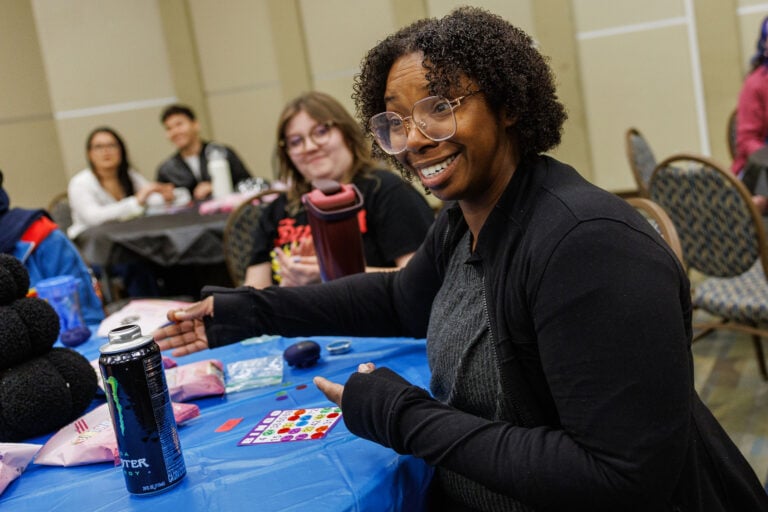
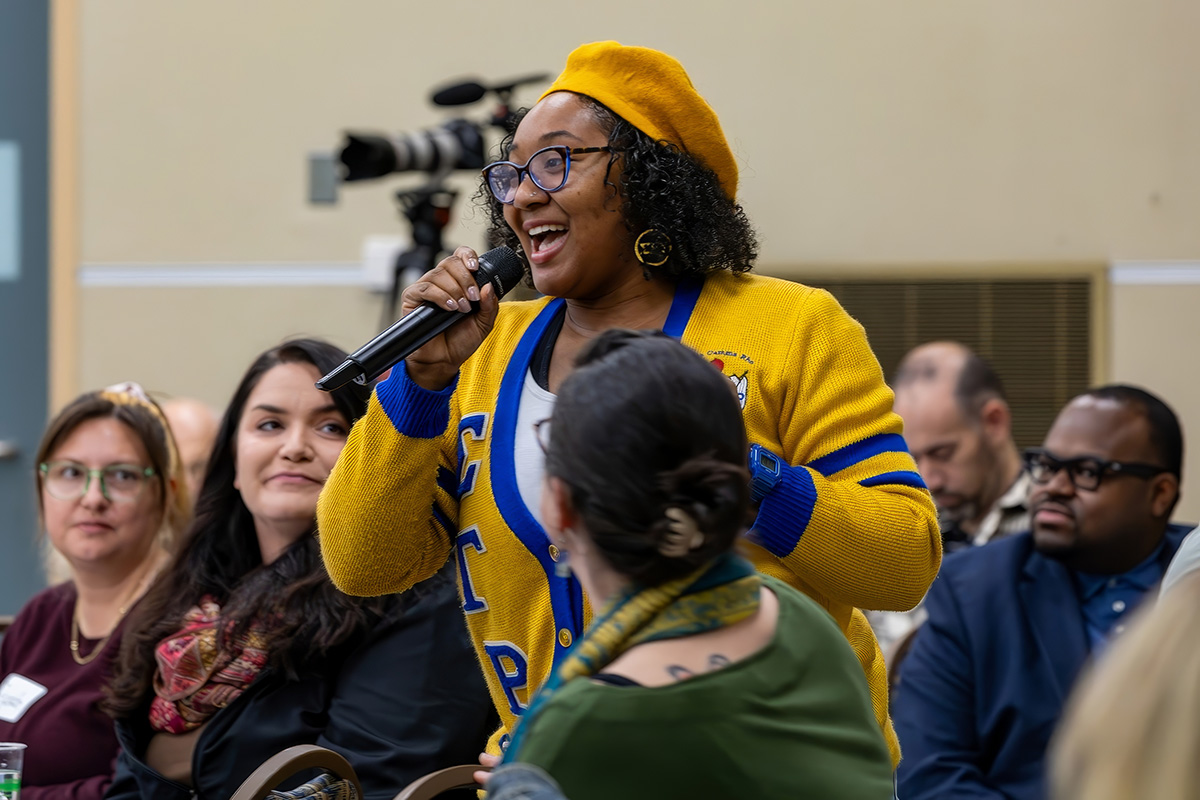
The University of Michigan-Flint kicked off three years of research and activities related to its “Cracks in the Pavement” grant from the Mellon Foundation, Nov. 6, by hosting nearly 200 local leaders, community members, UM-Flint faculty, students, and staff to explore creative approaches to building democracy at the regional level.
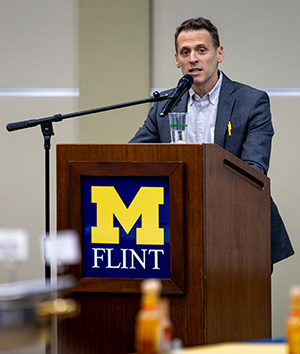
“We chose to kick off our research activities by hosting this community symposium to elevate the work that is already being done in this community, and to help students and faculty think about ways to incorporate democracy as a concept in their coursework,” said Jacob Lederman, associate professor of sociology and the principal investigator on the Mellon Grant. “We want to foster collaborations between the faculty and community members so when the faculty are developing new course modules next semester, they’re bringing in some of these themes and, hopefully, they’ll utilize these connections and involve the community in their course design.”
The symposium included three moderated keynote discussions and nine unique breakout sessions that explored topics ranging from immigration and labor to civic clubs to the role of the built environment in our concepts of community.
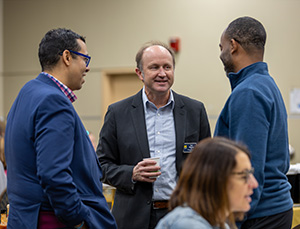
“This is a real opportunity for the community and the university to come together as partners and explore ways to co-create a shared future,” said Ted Rippey, dean of the College of Arts, Sciences & Education. “It was exciting to learn with other members in the community, to hear from the panelists in the Community Wealth Building session, and to see members of the audience really perk up, scribbling on their notepads, exchanging ideas. UM-Flint should be at the nexus of sharing experiences and knowledge in a way that connects the community more closely and this event really brings that intention to life.”
The first keynote conversation focused on community wealth building, particularly in cities like Flint. Guest panelists included Joe Guinan, president of The Democracy Collaborative; Esteban Kelly, executive director of the U.S. Federation of Worker Cooperatives; and Brigitte Brown Jackson and Taylor Flynn of the North Flint Food Market.
As one approach to local economic development, community wealth building is based on democratic participation to build equitable wealth, using tools such as worker cooperatives, community land trusts, public banks and more.
“This symposium has really framed a very important question for communities across the Midwest – but also, frankly, throughout the United States – about how you move forward with what you’ve got, given that nobody is apparently coming to save us,” said Guinan. “We have tremendous resources, people, ideas – in institutions both big and small – here in Flint. Seeing people take steps on a journey to reinvent and reimagine their community, repurposing what they have to build a better future for everyone, is inspiring. Symposia like these are essential for circulating these ideas, opening people’s minds to possibilities, and helping them realize that it’s not as difficult as they might think. They can be the spark that lights people’s imaginations and moves people and institutions toward action.”
One community organization committed to reinventing the community is the North Flint Food Market, a food cooperative owned by area residents, organizations, churches and businesses, which is part of the larger North Flint Health & Wellness Hub.
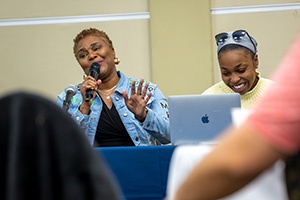
“I spoke a bit about certain principles that guide us, one of which is ‘Kuumba,’ or creativity. When people talk about being Flint Strong, I see it as our ability to channel our creativity through strength and resiliency,” said Brown Jackson, who serves as the North Flint Food Market’s board chair. “We’ve had to withstand a lot, but our creativity has allowed groups like the Flint Reinvestment Corporation or the Food Market to come into existence. It was to solve a problem because, ultimately, as human beings, we are problem solvers, and we have the ingenuity in Flint to solve every problem that we need to. Now, we may need some assistance from outside resources, but we are the help that we have been looking for.”
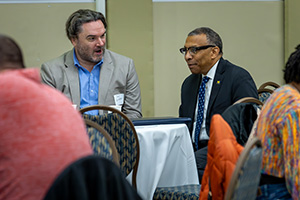
UM-Flint Chancellor Laurence Alexander attended the community wealth-building session and found it salient to the university’s overall mission. “I think that our position is as an anchor in community wealth building, bringing our expertise in education, learning and research, to collaborate and partner more closely with the groups in our community who are already working so hard on these ideas,” he said. “I’m grateful that Jacob Lederman and Kim Saks, as well as the countless others at the university, produced this important event, because it was an ideal environment to bring together so many people from various sectors – grassroots, philanthropy, small businesses, nonprofits, advocacy organizations – to discuss the issues around building wealth in Flint. Flint needs it. Flint is resilient, but it’s been through a lot, and while opportunity abounds, I know that our institution can play a key role in bringing some of these ideas and programs to fruition.”
The first round of breakout sessions featured topics exploring the intersection of democracy with immigration, the arts, community development, and student experiences.
In her session about democracy and immigrant rights, panelist Lucine Jarrah, executive director of the Arab American Heritage Council, was delighted by the attendees’ curiosity and desire to work with organizations like hers to improve the immigrant experience in Flint.
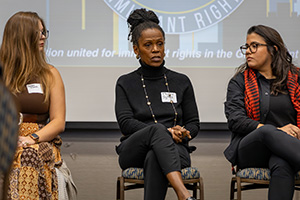
“Our panel specifically focused on the work that we do in the Flint Alliance for Immigrant Rights, specifically how, as a coalition of community stakeholders from every sector imaginable – UM-Flint faculty, nonprofit organizations, social service agencies, law firms – we’ve come together to achieve impressive results within such a short timeframe,” said Jarrah. “For example, we successfully lobbied for the Metro Police Authority to rescind its cooperation agreement with the U.S. Immigration and Customs Enforcement. This was a massive win for the safety and dignity of our immigrant neighbors, and we wanted to highlight how anyone can get involved with this fight for immigrant rights.”
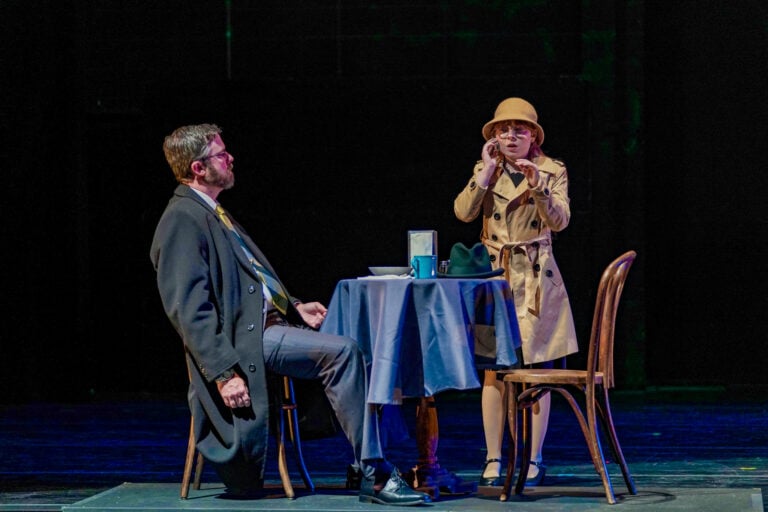
In their session about art and democracy, “Scars of Muted Voices,” lecturer in English Stephanie Vidaillet Gelderloos and Detroit artist Elton Monroy Duran demonstrated how an interdisciplinary perspective on democracy can create an expansive environment for community building.
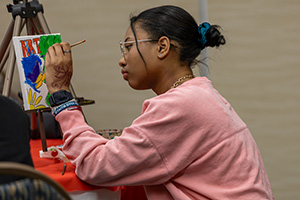
“When I first learned about this grant, I thought, ‘What can I do? What can I bring to this project?’ I teach English, so I’m not really versed in political science. After a group brainstorming session, I thought about art, specifically, how art plays out in the question of how we practice and enact democracy,” said Vidaillet Gelderloos. “I immediately thought of Elton, who is a muralist from the neighborhood I grew up in, Southwest Detroit, and I know that murals are about the power of our voices, about expressing things that we can’t necessarily say or we don’t have the platform to share. So I invited him to collaborate with me on developing this breakout session as a way of bringing artistic practice into the conversation.”
Alyssia Washington, a 2025 UM-Flint graduate and current Master of Public Administration student, led a student-focused breakout session exploring opportunities to promote democracy.
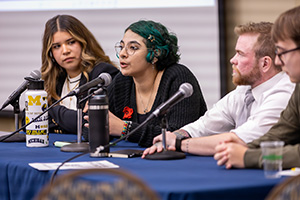
“It’s important to strengthen the bonds of community and for students and young people to understand that they have just as much of a say as anyone else, and that they have power,” Washington said. I’m excited to be part of this symposium because I have personally gained a lot of experience in this kind of work during my time at UM-Flint, and I want to share with other students what I have done, what they can do, and hopefully inspire them to become more engaged.”
After the breakout sessions, the second keynote conversation featured Thea Lee, former president of the Economic Policy Institute and undersecretary of the Bureau of International Labor Affairs from 2021-25. Lee focused on the intersection of labor, democracy and Flint, specifically from a global perspective.
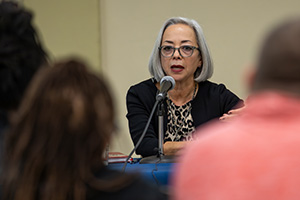
“I was really looking forward to trying to make some connections between Flint and labor and democracy and the global economy, because a lot of my work is international, and yet I’m very aware of how locally rooted the work that we do is, and how it impacts American workers and American businesses,” Lee said. “Flint is an excellent example of being at that crossroads, and what’s amazing about this symposium is that it’s bringing together community activists, students, workers, academics, and so on, to make better connections and create more understanding between those groups. If we can do that, we can be more effective in fighting for a stronger, more robust democracy, as well as greater protections for workers and their rights. I think events like this make Flint just a really interesting place to be.”
During the symposium’s closing conversation, one of the panelists, Kenneth Frierson of the Ruth Mott Foundation, was particularly inspired by the afternoon breakout session focused on democracy and local journalism.
“Civic engagement is one of the core values at the foundation, and I enjoyed the session on local journalism because I’m often wondering, ‘how can we know what’s happening?’ That session brought to light how we can support local journalism so we can be more inclined, as a community, to trust it as opposed to national outlets, so learning about what that process looks like, how to rebuild trust in community journalism, was interesting,” he said. Other breakout sessions throughout the day included explorations of community design and its impact on belonging, labor activism and immigrant communities, proposals for new park development and the revitalization of Riverbank Park as a conduit for community building, and the 137-year-strong Garland Street Literary Club and how civic clubs might be the solution to the polarization we’re currently experiencing at a national level.
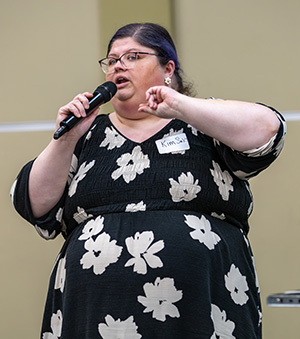
“The breakout sessions show the breadth and depth of activity that’s going on in the community and the ideas about these issues,” said Kimberly Saks, associate professor of political science and one of the event’s organizers. “As a result of this symposium, I want to see a strengthening of relationships both between the university community and the community at large.”
Later in the day, the symposium moved from the UM-Flint campus to the Flint Farmers’ Market, beginning with a group discussion on how local organizations are working together to create alternative democratic models. Moderated by James Ananich, president and CEO of the Greater Flint Health Coalition, the panel featured Lucine Jarrah, Samantha Farah of The Crim Foundation, Tony Vu of Flint Social Club, and Carma Lewis of Flint Neighborhoods United.
“I was excited to be a part of this because I want more people to know about Flint Neighborhoods United, and that we’re an advocacy organization focused on making our communities stronger,” said Lewis. “I was excited about the session on Riverbank Park because it’s something I feel we can promote and share with our community, connect with local neighborhood associations to bring more community spaces to Flint.”
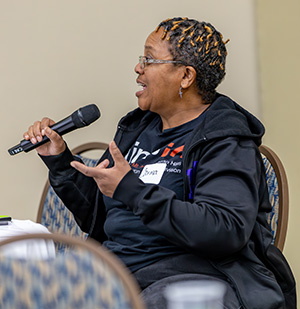
For Farah, she wasn’t certain at first how Crim could fit into a conversation about local democracy. “When I first heard about the topic, I wondered, ‘Are we participating in democracy at Crim?’ and after some thought, I realized, ‘heck yeah, we are.’ It’s what we do every day, building community and promoting civic participation, which is so important for our society right now, and has been happening across our city for a while,” she said. “So this event allowed us to not only share what we’ve learned in terms of collaborating with different groups in Flint, but also explore how we can do that more and with other organizations.”
As the session’s moderator, Ananich was focused on listening, hearing, and learning. “I want to hear what the community has to say, especially how we can continue to break down barriers between the university and the community. Sometimes, our work can be siloed, and people don’t always know what we’re doing unless they’re involved in it directly, so I am hopeful that this event and upcoming work will result in more integration,” he said.
Closing out the symposium was a final conversation on the future of democracy, from the local to the global, featuring speakers like former Rep. Dan Kildee, president of the Community Foundation of Greater Flint; Jenna Bednar, professor of political science and public policy and cochair for the Presidential Initiative on Democracy, Civic Empowerment, and Global Engagement at the University of Michigan; Pastor Patrick McNeal, director of North Flint Neighborhood Action Council; and Kenneth Frierson.
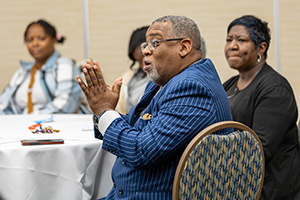
Bednar used the day to learn from local leaders, informing her own work at U-M. “I was really impressed with how seriously everybody was talking about and building up the agency of the citizens of Flint. We can’t have things happen to them; instead, things happen because of them, so it’s really about empowerment. Civic empowerment is a term that is often thrown around, but I see it happening here,” she said. “Today’s group is highly engaged, but what about the rest of Flint? How do you diffuse the energy in this room and ensure it happens throughout the community? I think that is, in part, the strength of the associations that I heard about today.”
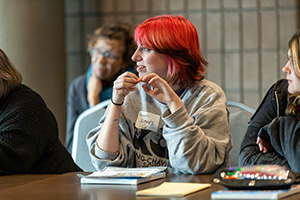
“I made the decision since I came back from Congress and joined the Community Foundation to put civic health at the center of our work because it’s clear to me that solving the big challenges that we face is most impacted by the ability of the people to organize themselves and speak with one voice,” said Kildee. “What I would like to see is the people who are in this room, they’re all leaders – at the university or in the community – and they exercise that leadership, maybe by trying to hold versions of this event in every neighborhood in Flint. It would be mainly to listen, but also to offer an opportunity to share ideas on how we might increase our own citizen involvement.
“Honestly, given the state of American politics, and I came from that world, I have more hope that these problems we’re facing can be solved locally. And that collective local action really is the way that we change this country.”