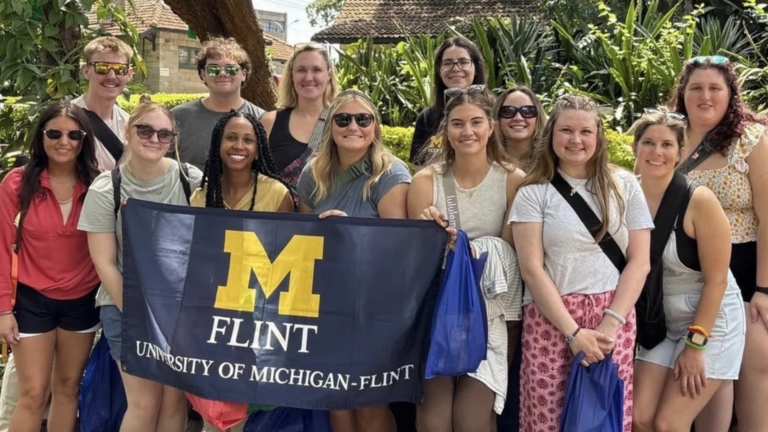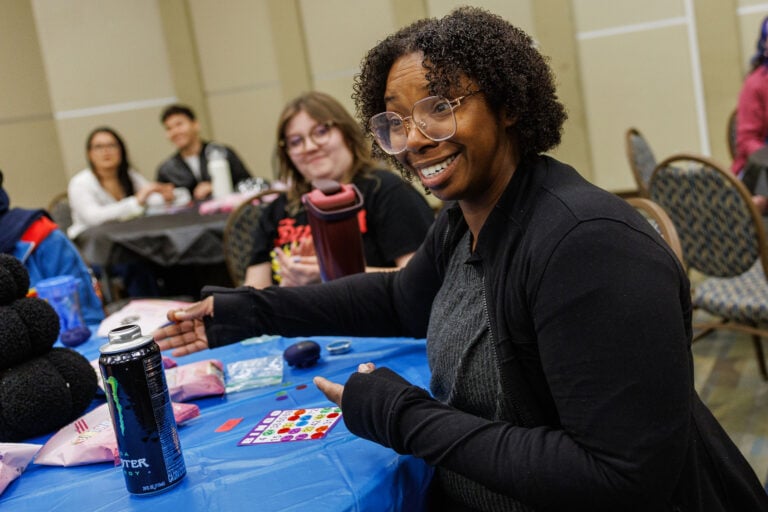
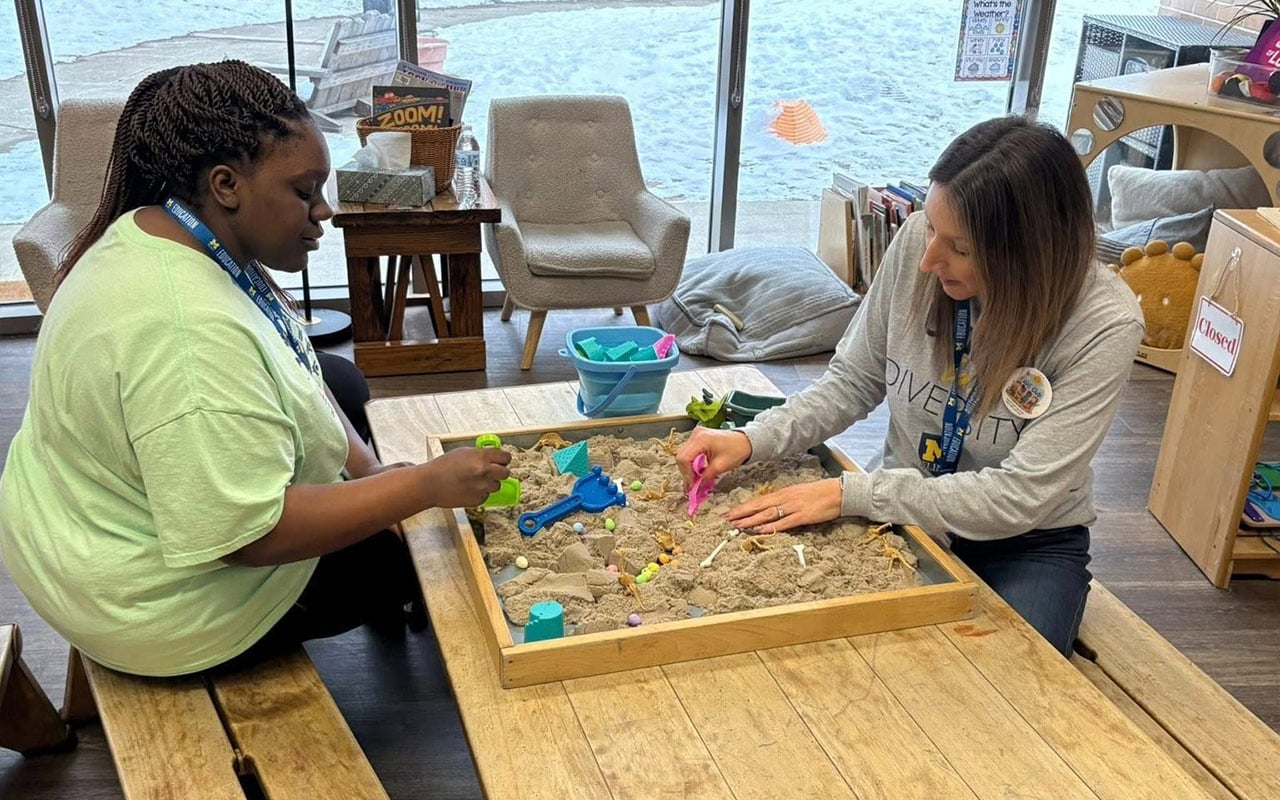
Whether it’s climbing under a weighted blanket, building with blocks and Play-Doh, or “cooking” a scrumptious feast in the imaginative playroom, the University of Michigan-Flint’s Care Club has space for every kind of play.
Care Club is a free community program providing children with autism, developmental disabilities and similar needs with an afternoon of play, creativity, and connection, while offering caregivers a well-deserved break. Happening inside UM-Flint’s Early Childhood Development Center, the event brings together faculty, students and specially trained staff to create a supportive play environment for children with special needs.
Sam Hilbert, an assistant professor of education, recognized the lack of support available to caregivers outside state-funded programs. Seeing the need for support in the community, she created Care Club in December 2025.

“We have the capacity to help them, and there’s a need not only in Flint, but in the special needs community. I wanted to do something. I wanted to make sure that we were serving the area that we work in,” said Hilbert.
Care Club launched in December 2025 with start-up funding through UM-Flint’s Wolverine Hub of Opportunity, Persistence and Excellence, and has continued to receive support from the College of Arts, Sciences & Education’s Theophilus S. Lynch Fund for Humanities.
The first Care Club event had a one-to-one staff-to-child ratio, welcoming six children with special needs, ages three through eight, for a three-hour afternoon of play in December 2025. Several of those families returned for an even larger second event, with 10 children attending the program in April 2026.

“The parents get to rest, or do whatever it is that they want to do — finish shopping, go on a date; it’s these little moments that I think people who have a neurotypical child take for granted,” said Hilbert. “We don’t realize these are luxuries in their life, and I think that it’s really enlightening to see what those small moments are.”
Frankie Sansiribhan, a senior elementary education major from Flushing, volunteered at Care Club this past year. For Sansiribhan, working with the kids and playing with them was rewarding enough, but knowing the support they were providing to the caregivers was a large reason for her involvement. Sansiribhan grew up watching her mother raise her brother, who is autistic, and recalled the impact it had. “I know what it looks like in people who care for children with special needs; they’re tired, and everyone needs a break sometimes,” she said.
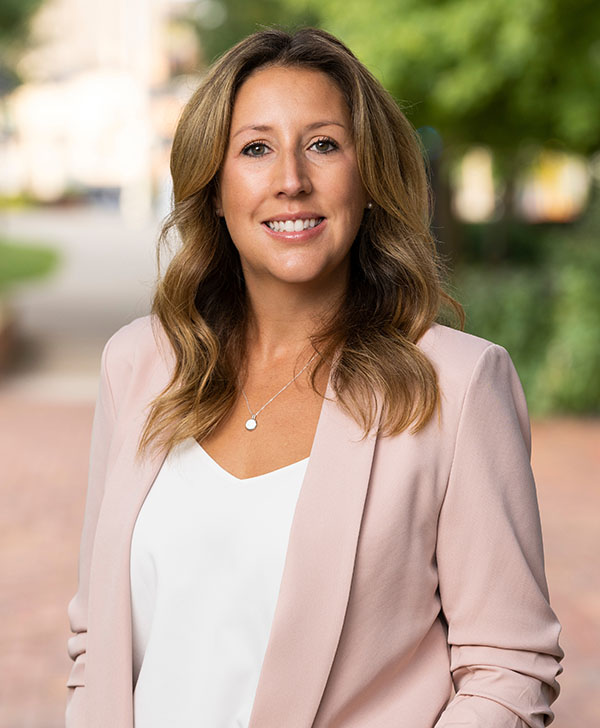
Care Club provides a safe, enjoyable experience for children, recognizing the hesitation caregivers often feel when leaving their child with someone else. “It’s nerve-wracking to leave your child, regardless, but especially when your child has complex needs, and you want to make sure those needs are understood and supported,” said Melissa Sreckovic, associate professor of education & honors program director. Students and faculty reviewed the special education curriculum as they prepared to apply it during Care Club. Aiming to create a space where caregivers could feel confident in the care their child was receiving, students learned about the realities of caring for children with special needs and best practices for providing a safe and positive environment.
Hilbert designed the program around flexible play, transforming ECDC classrooms into spaces for crafts, technology, imaginative play, and sensory activities—including a quiet room with weighted blankets and a blackout tent. Children were free to move between rooms while UM-Flint students engaged with each child in the way that best suited them. “You have to meet kids where they’re at; play comes in many different forms, and there’s not one right way to play,” said Sreckovic.
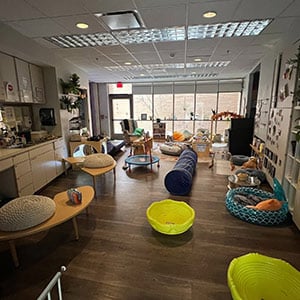
Due to her personal experiences, Sansiribhan was ready for the realities of caring for children with special needs, but was surprised by how outgoing some of the children were. “A lot of them would come right up to you and want to play with you. And I thought that was really cool that they didn’t know me, but they trusted me enough to ask, ‘Hey, do you want to play with me?’”
Sansiribhan remembers playing at the dollhouse with a young girl. At pick-up time, the little girl said she wanted to stay and refused to leave until Sansiribhan gave her a hug. “It made me really happy that I was able to make her feel safe,” said Sansiribhan.
Hilbert, Sreckovic and Sansiribhan all fondly recalled one child who simply wanted to be held the entire event, so faculty and students took turns carrying him up and down the hallway, talking and watching others together. “I think it’s really incredible for our students to see what it’s like to be a caring special education teacher,” said Hilbert.
Beyond supporting families, Care Club gives future educators valuable experience working with children outside a traditional classroom. Students gain a deeper understanding of children with disabilities, their strengths, and the realities families navigate every day. Many of the students had a positive experience and formed meaningful connections with the children by the end of the event.
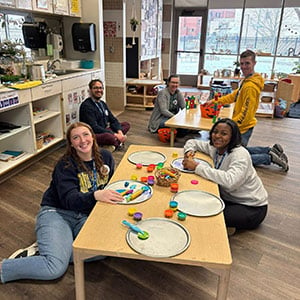
“I hope that it opens their eyes to the reality of the lived experience of these families. In the special education field, we don’t have the luxury of not considering what happens outside of our classrooms,” said Hilbert.
Care Club also demonstrates the value of play for UM-Flint students planning to enter the teaching field. “Sometimes in the K-12 world, there’s so much pressure to learn this, learn this, l test, test, test. But so much learning happens through play,” Sreckovic said. “The goal is for students to take some of these experiences, no matter how small, and apply them in their future classrooms.”
Care Club welcomes volunteers from all disciplines because disability awareness benefits every profession, according to Sreckovic. “More than 25% of adults in the United States have a disability. No matter what career field you enter, you’re going to interact with people with disabilities, whether they’re colleagues, clients, or members of the community. You may also work alongside people who have children or other family members with disabilities,” she said. “Having a greater understanding of disability and feeling more comfortable interacting with people with disabilities will benefit you in any career. And it’s fun. It’s a great way to give back to your community while having fun and building meaningful connections.”
Beginning this fall, Care Club plans to increase the frequency of its events and expand programming to include adults ages 27–40 with disabilities. Upcoming Care Club event information can be found on the Council for Disability Concerns website.