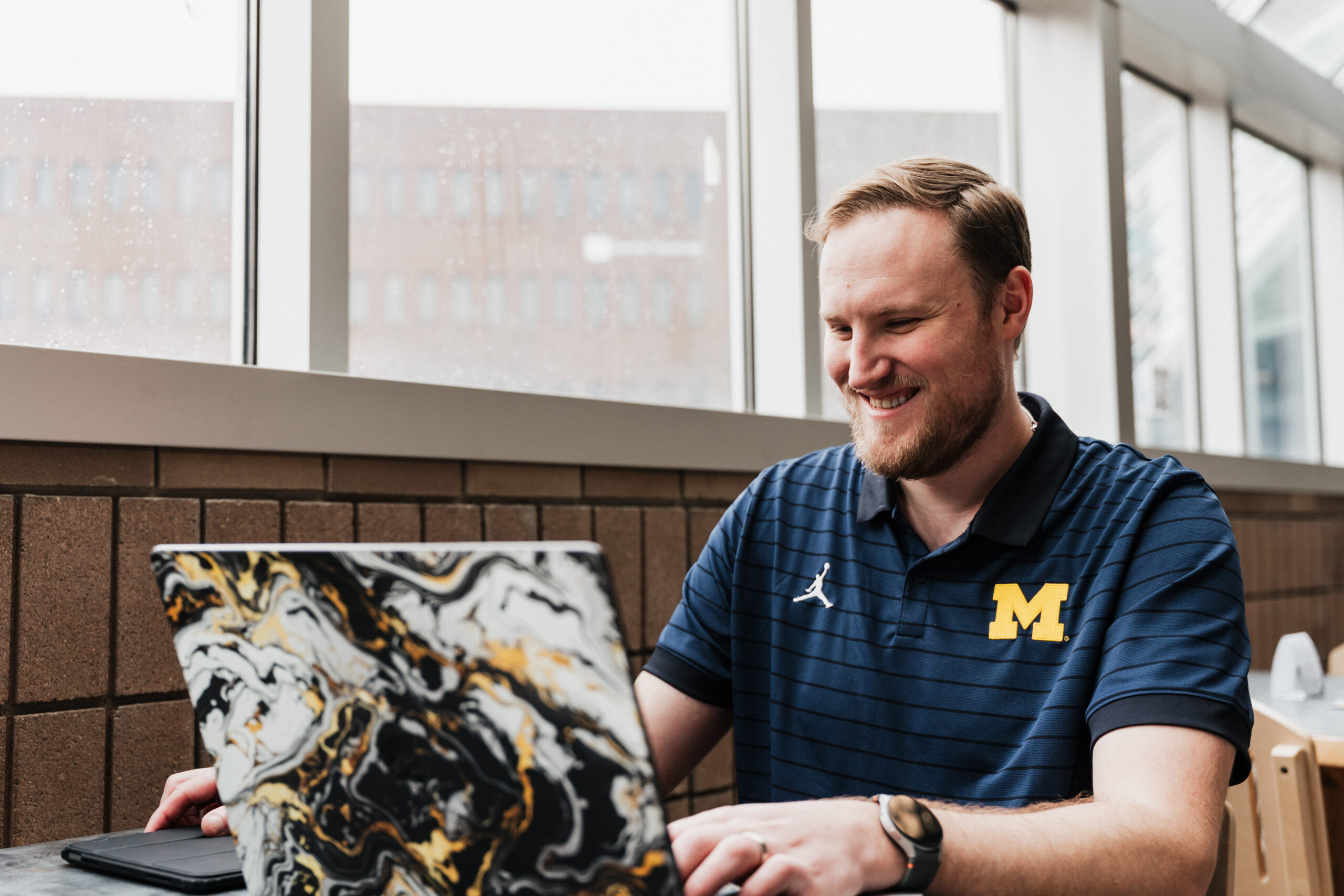
Many people return to school with the intention of starting over, searching for more or just looking for a new direction. But for some, with the right guidance, that career reboot can take them further than they ever thought possible. Take Zach Thomas of Sterling Heights, for example, whose enrollment at the University of Michigan-Flint’s College of Innovation & Technology turned a layoff into a launchpad.
Thomas spent years building a career in software engineering in an unconventional way. He started in customer service, completed a web development boot camp, and eventually transitioned into the field he loved. But when a six-month layoff hit, he ran into a frustrating wall: without a college degree, many employers wouldn’t even grant him an interview.
He resolved to finish what he’d started. After rebuilding his GPA at Macomb Community College, Thomas was accepted to UM-Flint and enrolled in the software engineering program. His original goal was straightforward.
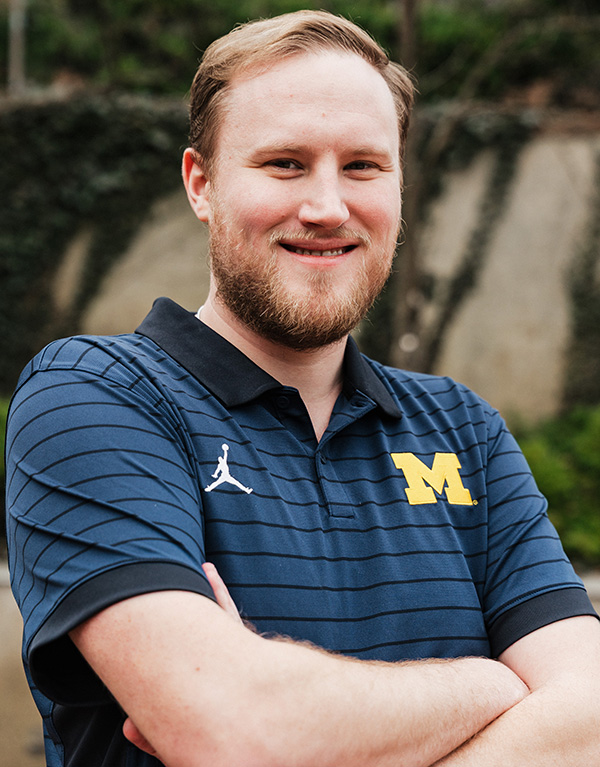
“When I started at CIT, my only goal was finishing my bachelor’s,” he said. “But in a year and a half, I went from someone who never saw myself finishing college to someone who is planning to be at college for the next four years.”
That expanded vision includes a joint B.S./M.S. in Software Engineering with a concentration in artificial intelligence, an associate degree from Macomb through a reverse transfer program, and a planned MBA from UM-Flint’s School of Management with a concentration in computer and information systems.
His wide-ranging studies are supported by the Go Blue Guarantee, a University of Michigan initiative that offers free and reduced tuition to qualifying students. Thomas is candid about its impact.
“I’ve worked hard to get where I am, and the Go Blue Guarantee was a major catalyst for that,” he said. “It’s been such a boon for me as someone headed back to school after going my own way for so long.”
In addition to this financial assistance, Thomas credits much of his academic momentum to the relationships he has built with faculty. As an engineer with a four-year career, he often approaches coursework differently than a student without industry experience, leveraging his background to experiment, research, and find his own solutions. That natural inclination helped him fit right in at CIT, which offers project-based learning that values practice over theory, and his professors encouraged him from day one.
“Every professor I’ve had treats me more like a colleague than a student,” he said. “Their goal is not to get you through college just on paper. Their goal is to help you learn, and treat you like you’re a human being, rather than a faceless number.”
Thomas credits Brian McBride, lecturer IV, as someone who gave him room to grow on his own terms. According to McBride, he and Thomas shared a strikingly similar backstory.
“Zach and I both came through the community college path to the decision to pursue higher education degrees in computer science,” McBride said. “Like him, I had previously worked in industry, which offers a connection to the skills, concepts, and tools being taught in computer science classes. Zach often attested to the importance of writing high quality code that is reliable, maintainable, secure, and readable. He even had anecdotes of real-life incidents at work that underscored some of the points I was making in lecture.”
That kind of personalized attention, Thomas said, is something he might not have found at a larger institution. The smaller class sizes and accessibility of faculty at UM-Flint have made a difference.
“It’s so nice not being in 200-person lecture halls where your professor doesn’t even know your name,” he said. “I walk into classes and I have a conversation about how my professor’s week was before class starts.”
Thomas has also sharpened his perspective on artificial intelligence through CIT’s curriculum, developing a nuanced view that balances enthusiasm with skepticism. Rather than using artificial intelligence to generate work, he leverages it as a research and documentation tool, a distinction he says the program helped him articulate.
“Using AI to write a paper is never going to help you learn,” he said. “But you can ask AI to search millions of articles to find an article you’re looking for. That data set, having access to a quick search, is so helpful.”
He credits the AI conversations he had at CIT with grounding his perspective in real-world applications.
“We focus on how AI is being used among regular people,” Thomas said. “It’s not simply a theoretical conversation. It’s ‘how are we doing it in the medical field, how are we doing it in the automotive field?’”
Beyond academics, Thomas is working to shape the UM-Flint experience for students who come after him. He is a member of the Honors Program and is advocating for a formal mentorship component within it. He also volunteers for Super Science Friday, a community outreach program that brings science education to K–12 students.
His motivation, he said, was forged by his work experience. He wants to be an advocate for workers with real experience and deep knowledge, but who have been shut out of opportunities by credential requirements—the same wall he once ran into himself.
“My goal in life has turned into putting myself in a position of technical or business leadership that allows me to provide other people the same opportunities that others provided for me,” he said. “I’m trying to convince other people to be different and to go at life their own way. My goal with my coursework at CIT is not just to skate through my education. It’s to leave this campus—and the surrounding area—a better place than when I arrived.”