UM-Flint joint research tackles chronic K-12 absenteeism
A student can't get to school because reliable transportation isn't available. Another misses class because their family is experiencing housing instability. Neither problem can be solved by simply telling students they need to show up.
That's one of the realities emerging from nearly a decade of research by Jeremy Singer, assistant professor of education at the University of Michigan-Flint, and Sarah Winchell Lenhoff, professor of educational leadership and policy studies at Wayne State University. Their work suggests that reducing chronic K-12 absenteeism requires looking beyond student and parent behavior and addressing the conditions outside the classroom that can keep students from attending school.
Their research has found that schools with high levels of chronic absenteeism are unlikely to solve the problem on their own. Instead, improving attendance may require a broader approach that connects schools with families, community organizations, and government agencies.
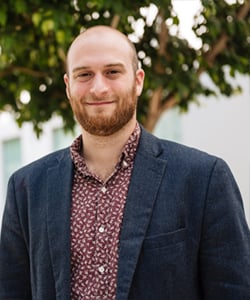
For almost a decade, Jeremy Singer, assistant professor of education, has researched student attendance and chronic absenteeism, recognizing that schools often cannot address the issue alone.
"We know about why they miss, the consequences, and even some of what works – but not what schools are actively doing," says Singer.
Lenhoff began researching student attendance in the Detroit area in 2016, in partnership with the Detroit Public Schools Community District and the community coalition Every School Day Counts Detroit. Singer joined the project soon after, and they have continued to produce research around the topic for a decade.
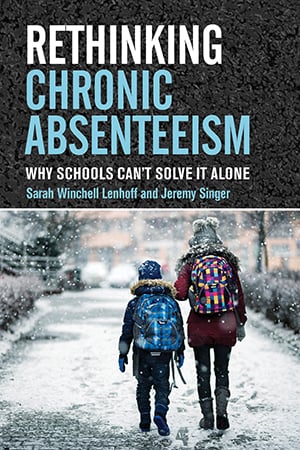
In March 2025, they published the book Rethinking Chronic Absenteeism: Why Schools Can't Solve It Alone, documenting the early stages of their work and reframing how we approach solutions.
While Lenhoff initially saw student attendance as simply counting pupils and taking attendance, Singer and Lenhoff now recognize it as an important indicator of student and family well-being.
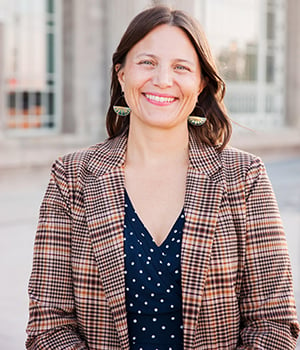
"When students and their families are well-supported inside and outside of school, they have good attendance. Getting to the bottom of why kids are missing school will help to improve youth and family outcomes beyond attendance, too," said Lenhoff.
Research links student attendance to student learning, engagement, social-emotional outcomes, and graduation rates, but schools often lack the support and resources to address the factors driving chronic absenteeism.
"School leaders are making a strong connection between student mental health and social and emotional well-being, and attendance," said Singer.
One of the book's key findings was that schools facing high levels of chronic absenteeism were not likely to solve the problem on their own. Lenhoff states that "government agencies and community groups must be involved in creating the conditions outside of school that will support student attendance."
This has become a greater issue in Michigan and across the country, as student attendance rates are lower than before the COVID-19 pandemic, with little recovery in sight.
Singer's interest led to a survey of Michigan schools in March 2024, which achieved a 41% response rate and yielded a representative picture of what was happening across the state. The survey aimed to gather information about what schools are doing, how they're doing it, and whether it seems to be having an effect. Singer said the survey offered insight into specific strategies schools are using, including "social and emotional learning in the classroom and restorative practices to address student behavior".
In August 2025, "How are Michigan's Schools Addressing Chronic Absenteeism?" received positive responses and interest for surveys in other states to provide similar snapshots and inform next steps.
School leaders across Michigan and other states have shared how useful this framework has been, encouraging further collaboration, including fruitful engagement with leaders in Georgia and Minnesota, as both states work to implement new state-level policy to improve student attendance.
With his colleagues, Singer published a paper comparing data from Michigan and Georgia titled "What are schools doing to improve attendance?" Evidence from Michigan and Georgia.
Singer presented promising practices to the Michigan Department of Education in October 2025, offering guidance and deepening understanding of the topic. A shorter version of the report, titled "What are Michigan Schools Doing to Reduce Chronic Absenteeism?," was also shared.
"When schools are put at the center of solving the problems for why students don't come, they end up spending a lot of time on issues they really don't have the power to solve," says Lenhoff.
A comparison of survey results from Michigan and Georgia found that most schools focused on changing student or parent behavior rather than addressing socioeconomic barriers such as unreliable transportation or unstable housing.
Public engagement seemed to be the logical next step for the research, as many of the identified barriers and obstacles are not ones a school system can combat on its own. A May 2026 report, Identifying Effective Attendance Strategies in Michigan, provided new evidence on "the relationship between school attendance strategies and student attendance outcomes in Michigan," said Singer.
Singer and colleagues examined the data for correlations between school strategies and positive attendance outcomes. Key findings included that some schools are more effective; more comprehensive approaches tend to be more effective; no single practice is universally effective; and implementation matters.
Potentially effective strategies included deep family engagement (e.g., home visits), personalized communication (e.g., text messages), and efforts to address out-of-school barriers (e.g., homelessness, transportation).
Moving forward, Lenhoff hopes to get the chance to "evaluate some initiatives outside of schools that could improve attendance, such as those that support student transportation or stable housing for families." Singer cited plans to identify districts doing exceptional work as targets for case studies and one-on-one interviews, and to shift the lens away from families and students and back to the schools themselves.
Next steps also include improving the accessibility of their research through data visualizations. The Detroit Partnership for Education Equity & Research at Wayne State University is already doing work in this area.
Singer's research is not only influencing how schools think about attendance, but also informing how future education researchers and leaders can approach complex problems. His work exemplifies the kind of evidence-based inquiry UM-Flint's Doctor of Education program teaches. As a large, long-term, mixed-methods study of a familiar topic, "this project serves as a good example of what it looks like to do research; we had to synthesize a lot of research to understand the types of questions we should be asking school leaders," said Singer.
The most recent policy report, Detroit Schools Outpace State in Improving Student Attendance, released in August 2026, outlines the substantial progress Detroit schools are making compared with other Michigan schools.




Audrey Scribner
Audrey Scribner is the events & engagement coordinator for the College of Arts, Sciences & Education.